
AI, AI, AI. I know, I know. It’s in every business conversation, especially those about marketing. Some people are overwhelmed by its limitless potential. Some are underwhelmed by its inability to accurately assess how many Rs are in the word strawberry. In both cases, it’s clear that AI search optimization is at the forefront of 2026 planning.
Can’t we ever just be whelmed? Sigh. That’s not the life of a B2B marketing leader, unfortunately.
So, as we all set our 2026 marketing plans, are we going all in on artificial intelligence or not? As ever, the answer is complicated.
AI is growing fast, and B2B companies will see a measurable impact from it this year. One way we’ll all feel it: we’re telling our clients to expect a 30-40 percent drop in web traffic. But that’s not as apocalyptic as it sounds. Why?
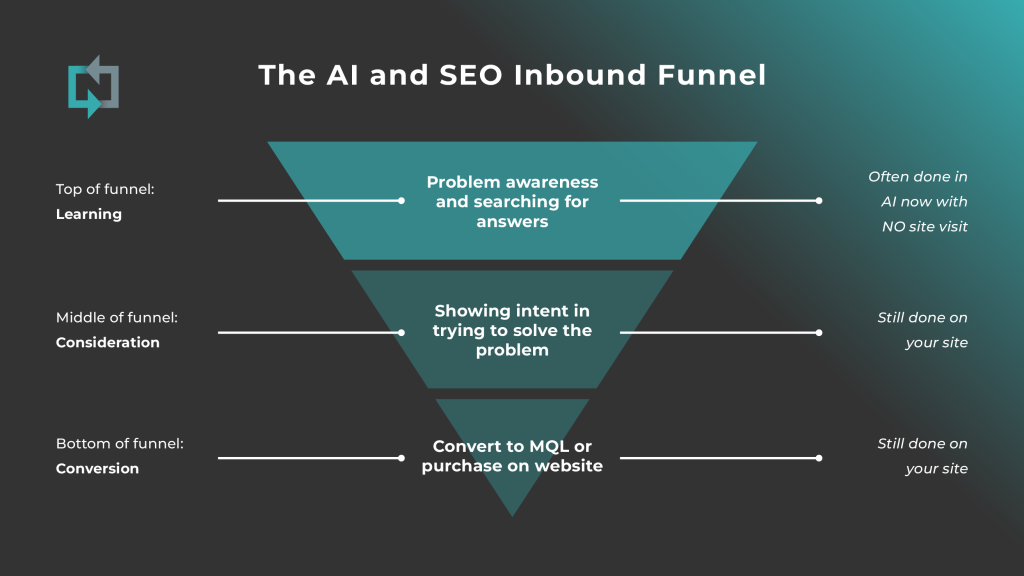
AI is eating the awareness stage that used to happen on your website.
Those of us who rode our dinosaurs to marketing school remember there are 3 buyer stages: Awareness > Consideration > Conversion. While complexity and sub-steps have been added over the years, these stages have held. It’s always been our job as marketers to win all three.
But ChatGPT, Claude, Perplexity, Gemini, Copilot, and so on, are all pretty good at pushing someone full speed into the consideration stage before they ever get to you. Addressing AI search optimization makes sure your company isn’t overlooked in this early stage.
Your B2B Buyer’s New AI Research Team
This is the future of answer engine optimization (AEO), which you may also hear called generative engine optimization (GEO). Prospects are doing research more quickly away from a business’s website, instead looking for answers on how to solve their problem through AI.
This will cut your top of funnel traffic, which means two things: you have to do AI search optimization work to show up in the first phase. You also have to do a better job in the consideration phase.
Here’s what’s happening in your prospect’s workflow right now:
Before they contact you, buyers are asking AI to:
- Come up with solutions and technology ideas to solve their business problems
- Assess costs, timelines, and resources needed for potential solutions
- Shortlist vendors based on specific criteria you’ve never discussed
- Compare your strengths and weaknesses against competitors
- Synthesize reviews, case studies, and third-party mentions
- Draft RFP outlines for how they think the problems they have should be solved
A lot of this initial research used to happen in Google, which led people to your website (if your SEO was good). But let me be blunt: Google fumbled the bag, as the kids say.
Presenting a list of links, many of which were paid ads that only loosely helped you find what you wanted, didn’t really answer the question searchers had, particularly at the top of the funnel. Even though answering the search question was the main purpose of Google, it’s being replaced because AI gives users a definitive and confident answer (whether that answer is right or made up is a conversation for a different post).
This is the end of top of funnel search for many (but not all!) people who used to visit your site during research, thus the drop in web traffic. They have awareness of a problem, and before moving fully to consideration, they want to know what’s possible and how to think about what comes next.
But there is good news for you. The complexity of a B2B buyer cycle still means multiple stakeholders in the consideration phase.
For example, if I want to buy something stupid off Instagram for $19, I don’t really have to talk with anyone. But, if I want to hire a new accountant (I don’t, Tony!) I have to talk with a few people internally and do my research on new firms. Your site should already be built for the consideration phase; you just need to double down on that with AI search optimization tactics and strategy.
Oh, and there is some additional good news. While AEO might seem scary and new, many of the fundamentals are rooted in SEO, so the time and energy you’ve invested there will still pay dividends.
Four Ways AI Is Hijacking the Traditional Funnel
- AI as the Gatekeeper — Your prospects aren’t scrolling through 10 blue links anymore. They’re asking AI for solutions that meet their needs. If your brand doesn’t appear in that AI-generated shortlist, you’re out before you knew you were in.
What it means for you: If your content isn’t structured, clear, and high-quality, AI tools won’t find you. Or worse, they’ll misrepresent you.
- AI as the Content Filter — Buyers are prompting AI to digest your case studies, whitepapers, and product pages, then report back only what’s “relevant.”
What it means for you: Your strongest proof points might never get seen if they’re buried in dense (and gated!) PDFs or poorly structured web pages. Content must be AI-readable, not just human-readable.
- AI as the Reputation Monitor — AI pulls from reviews, social mentions, forum posts, and press coverage to deliver real-time brand reputation summaries.
What it means for you: Your entire digital footprint, not just your polished marketing materials, now feeds directly into buyer perception.
- AI as the Deal Advisor — At contract time, buyers are asking AI to compare pricing models, flag hidden costs, and draft negotiation points.
What it means for you: Pricing opacity and complex terms that were used to create negotiation leverage now create deal friction.
Where B2B Brands Need to Start with AEO
Many AI-based companies will say digital marketing and SEO are dead. That’s not the case. Like SEO was 10 to 15 years ago, AI search optimization is a growing tool that’s part of your marketing process if you want to evolve. It’s growing fast, so AEO needs to be a focus, but probably not your whole marketing budget.
Where should you start if you haven’t done any AI search optimization so far? I’m glad you asked!
Start here:
- Audit your content for AI readability: Can large language models easily extract, verify, and cite your key claims? Structured data, clear headings, and concise answers matter more than ever.
- Address multiple stakeholders in every piece: Your content should anticipate questions from technical, financial, and operational perspectives simultaneously.
- Own your digital reputation: Monitor what’s being said about you across the web (reviews, social, forums) because AI is already aggregating it. By the way, like many things AI-related, this is a good practice anyway!
- Make pricing, policies, and terms accessible, where possible: Buyers armed with AI advisors will comparison-shop your contract language. They will ask for policies and pricing across competitors. If they can find your competitors’ information and not yours, you’re behind.
- Test how AI sees you: Search your own brand in ChatGPT, Perplexity, and Claude. What comes up? What’s missing? Is it right? It’s worth checking out your competitors as well.
Want to get more in the weeds than that? So do we! We’re doing AEO work for our client sites to help make sure they have a robust presence in AI.
AI and AEO is Impacting Decisions
Google gave buyers information. AI pushes them further down the funnel by giving them the information they need to make a buying decision.
This isn’t a 2027 problem. If your content strategy hasn’t evolved beyond your keyword rank, you’re slowly being erased in the buying process. That doesn’t mean you should forego SEO. It means you should intentionally add AI search optimization.