
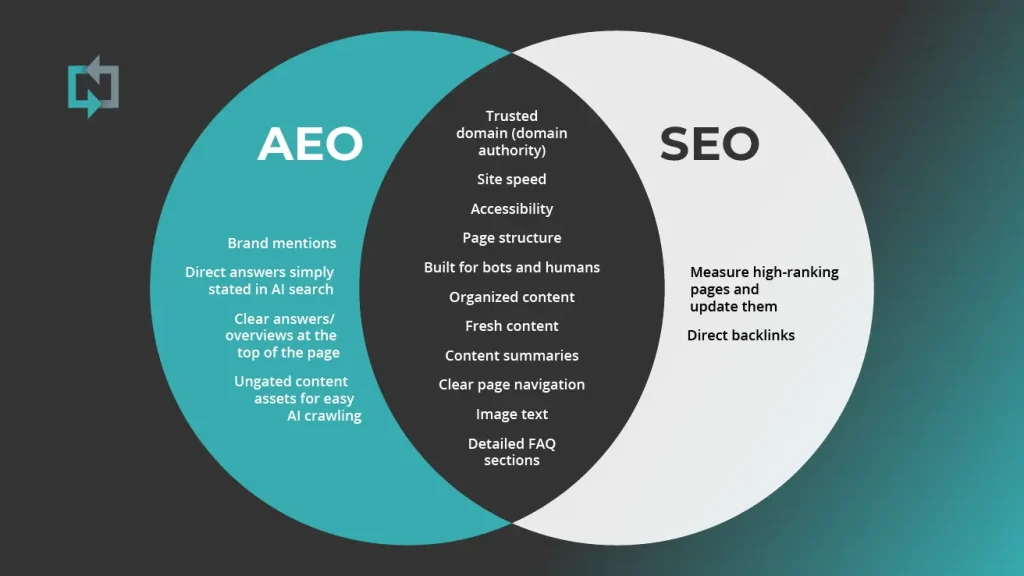
There’s a lot of commotion in the search engine optimization (SEO) space right now. The rise of large language models (LLMs) and Google AI overviews has fundamentally changed how people search online. And it’s created a new subset of SEO — answer engine optimization (AEO). While traditional SEO focuses on driving traffic to a website via search engine results pages, AEO optimizes content for AI, Google AI overviews, and more. This evolution has prompted many business leaders to ask:
- Is AEO replacing SEO?
- How do I get AI tools to cite my brand as a source?
- Should I continue to invest in traditional SEO?
SEO is still an important practice for many businesses. However, content marketing has now evolved. And, organizational leaders need to keep up. Below, we’re highlighting the difference between SEO vs. AEO, how SEO practices translate to AEO results, and what you can do to optimize your efforts in the future.
SEO vs. AEO: What’s the Difference?
Before we get into how the search space is changing, let’s talk about SEO vs. AEO.
Traditional SEO focuses on targeting keywords through blogs or webpages. Let’s say we’re working with a company that services elevators. How are their customers finding them? They might go to a search engine like Google and type in elevator maintenance providers. Then, they’ll see the results, click into a website, and do research on whether that company is right for them. If that company seems like a good fit, the searcher may fill out a contact form to request an initial consultation.
SEO focuses on creating content that incorporates keywords to get a website to rank higher on the search engine results page (SERP). In this example, we’d create content using the keyword elevator maintenance providers. It tells a search engine, “Hey, this is what this company does. If people are looking for an elevator maintenance provider, you might want to suggest this website.” If done correctly, a website can rank in the top spot on search engines for hundreds of terms. This results in more traffic to the site — and more contact form submissions.
Want to see how we increased search visibility for Southwest Elevator? Read our case study here.
AEO has similar principles to SEO, but it’s slightly different. As mentioned above, AEO is all about optimizing content for AI and Google AI overviews, and more. Someone might log into a website like ChatGPT or Claude and ask a question like what are the best elevator maintenance providers in Florida? The AI will give a list of providers to look into.
A searcher might also type the same query into Google and get an AI overview. These are also known as “zero-click answers.” The searcher can get their answer without having to click into multiple websites, which streamlines the process.
So, how does AI get its answers? According to ChatGPT’s website, it gathers information from three sources:
- Information that is publicly available on the internet
- Information that OpenAI partners with third parties to access
- Information that users, human trainers, and researchers provide or generate
LLMs scrape data from the internet to determine what results to provide to a searcher. That means blogs and webpages that are optimized for certain keywords are still important in the age of AI. Using this method, businesses are much more likely to appear in AI results, which results in more traffic to a site and more leads. Want proof? Skip to the How SEO Efforts Produce AI Leads section of this blog.
Here’s a quick example using the same query we examined in the SEO section above. We typed in what are the best elevator maintenance providers in Florida into Google. The AI overview had this to say:
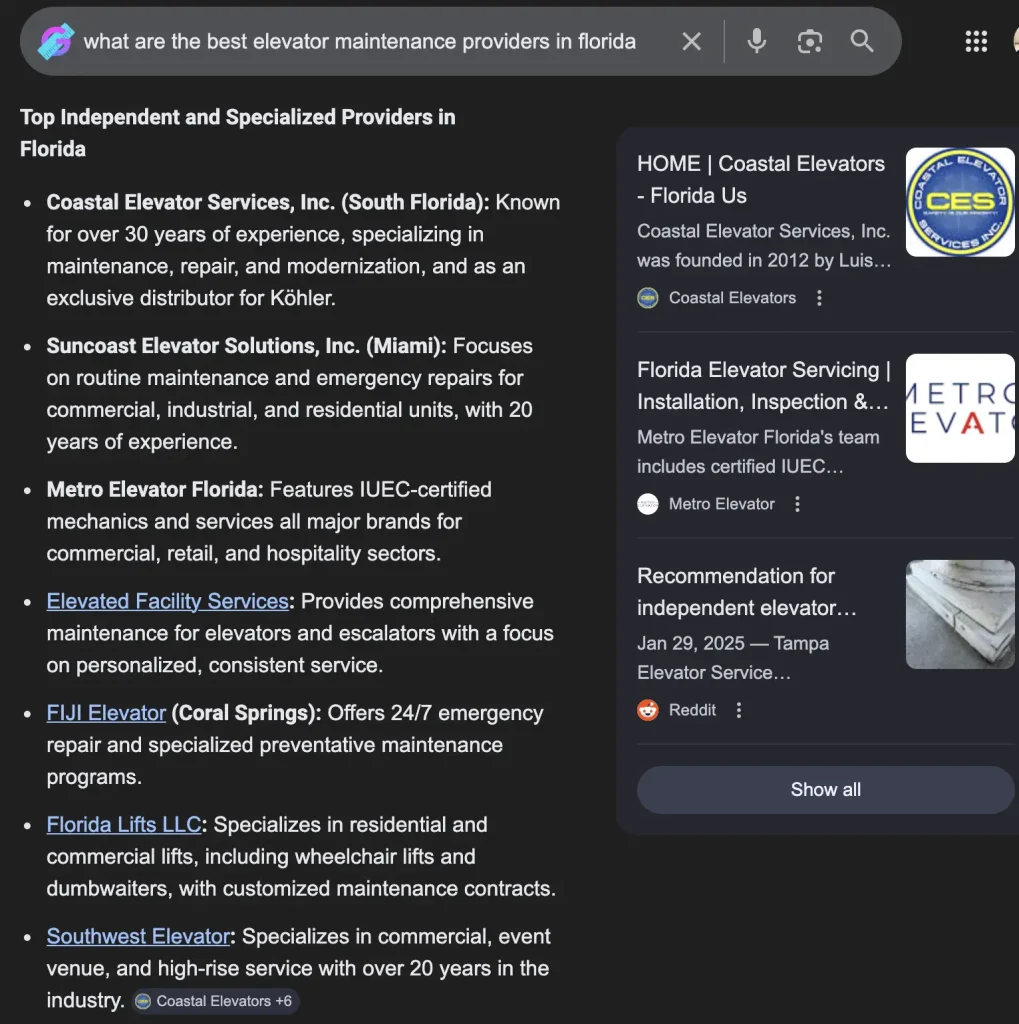
Southwest Elevator appeared in the results, in part thanks to our ongoing SEO work with the business. So, now you understand SEO vs. AEO and how it can affect results for many businesses. But what about actual leads that come from both of these channels?
How SEO Efforts Produce AI Leads
As mentioned above, SEO efforts increase the likelihood of a business ranking higher on the SERP. This translates to more traffic to a site and more leads from that traffic. SEO leads are defined as “organic traffic.”
At NgageContent, we’ve been working with Jamestown Container for years to develop high-quality content that pulls in leads from organic traffic. Each month, the site can pull in a considerable amount of leads that are excited to work with the Jamestown team. Now, that content has now helped Jamestown rank in AI results, pulling in even more leads each month.
The Fibre Box Association (FBA) estimates that there are over 1,000 corrugated manufacturing facilities throughout the U.S. That’s a lot of companies to compete with in AI overviews. But because of Jamestown Container’s reputation and investment in SEO through NgageContent, they’ve been able to break into the top 10 recommended companies.
When you type “best corrugated box manufacturers” into ChatGPT, for example, these are the results you get: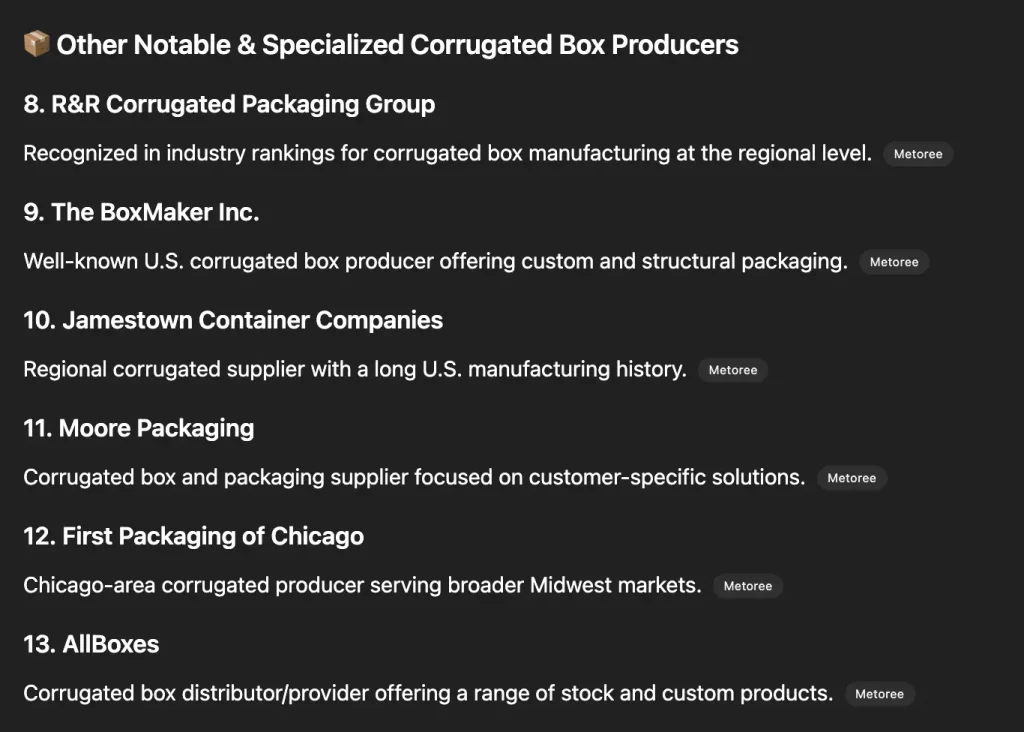
Jamestown appears in the top 10, right after some of the largest companies in the U.S. And the company isn’t just being recommended on ChatGPT. Perplexity also had this to say about Jamestown: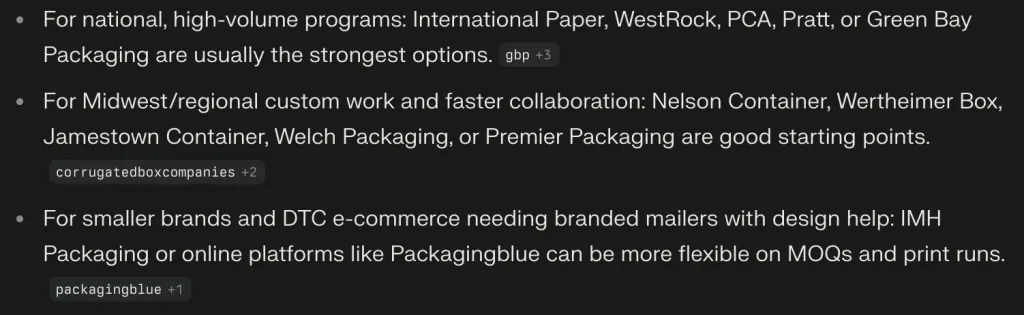
These recommendations are turning into real results for the business. Over the last six months, Jamestown has received:
| Month | AI Contact Form Referral Views | AI Contact Form Submissions | Conversion Rate |
|---|---|---|---|
| Month 1 | 4 | 1 | 25% |
| Month 2 | 3 | 3 | 100% |
| Month 3 | 3 | 1 | 33.33% |
| Month 4 | 5 | 5 | 100% |
| Month 5 | 6 | 1 | 16.67% |
| Month 6 | 5 | 1 | 20% |
In six months, AI referrals have led to 12 real business opportunities for Jamestown Container. While organic search submissions far outnumber AI submissions, it’s still a great addition to the business. It’s also not uncommon for AI submissions to have a similar or higher conversion rate than organic search submissions.
Will AEO Replace SEO?
It’s unlikely that AEO will fully replace SEO. Instead, the two will work in tandem to generate even more leads for businesses. Using SEO practices to rank higher on search engines is still important, seeing as 5 trillion Google searches are performed every year.
But now, businesses also need to consider how they’re showing up in AI-generated answers. Semrush’s July 2025 AI Search Study projects AI search traffic could surpass traditional search within two to four years. If an organization isn’t considering how it’s showing up in AI search results, it could lose out on valuable business opportunities in the future.
So, What Do I Do?
Investing in high-quality SEO services can help you pull in more leads from both SEO and AEO sources. Content should still follow typical SEO standards, but it should also be optimized for AI models. This might include using strategies like:
- Structured content: Break information down into blocks that are more AI-digestible
- TL;DR blocks: Content either at the beginning or end of the content that summarizes what the page/blog is about
- Headings: Use clear headings and subheadings so AI can identify distinct sections
- Key terms: Repeat keywords naturally so they’re recognizable in context
There are other steps you can take to make your content more optimized for AI, as well. A reputable SEO partner can help you optimize your online presence for the future.
Partner with NgageContent for Your Content Marketing Needs
Are you ready to create a content marketing strategy that boosts your business’s visibility in AI and organic search? Contact NgageContent. For more than a decade, our team has been providing high-quality content marketing solutions designed to capture more online traffic. Contact us today to get started.